The Jewel House in the Tower of London
The Crown Jewels are displayed at the Jewel House in the Tower of London and can be viewed there by the public.
The coronation of a new sovereign is one of the monarchy's most glittering pageants, staged in the gothic splendour of ancient Westminster Abbey, where every King and Queen of England, with the exception of Edward V and Edward VIII, has been crowned since King Harold II in 1066. This time-honoured ritual emphasizes the continuity and majesty of the British monarchy.
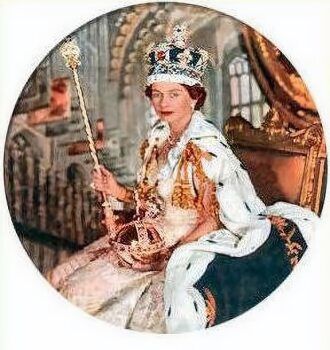
The oldest items in the present coronation regalia date from the Restoration, when they were made for the coronation of King Charles II. The original Crown Jewels were destroyed by Oliver Cromwell following the execution of Charles I in 1649, as they were then considered to be redundant. In an appalling act of historical vandalism, Cromwell had the entire collection sold or melted down and made into coin.
Many of these irreplaceable and historic pieces, collected over the centuries, were Saxon or Medieval and included Alfred the Great's State Crown and the eleventh century crown of Queen Edith, wife of Edward the Confessor. There is no certain depiction of the most precious item of the collection, the Crown of St.Edward the Confessor, ( re-named King Alfred's crown after the Reformation). We know the appearance of the State Crown of Henry VII, which shared their fate, as it is depicted in some of the portraits Charles I, by Daniel Mytens and Van Dyck. There were also various sceptres, swords, coronets, rings and an Anglo-Saxon comb, Some of the pieces were probably reclaimed burial regalia, including those stripped from the rich shrine of Edward the Confessor in Westminster Abbey by Henry VIII. Various medieval garments used in past coronation ceremonies were also sold off at the time, an irreparable loss.
The Ampulla and Spoon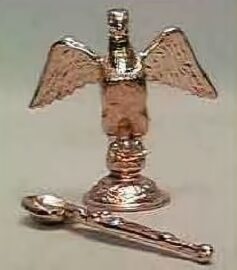
The only item in the present collection to survive the Commonwealth is the golden Ampulla and spoon.
The Ampulla is used in the coronation ceremony to annoint the monarch's head palms and breast with holy oil.
The Imperial Crown of State contains the principal surviving historic jewels, which were recovered at the time of the Restoration. These include Edward the Confessor's sapphire, which is set in a Maltese cross at the top of the crown. This sapphire was once part of a ring owned by Edward the Confessor, which was buried with him in 1066. In 1101, when his shrine was opened and the ring removed, the sapphire was re-set in a crown worn by Henry I.
The ruby which adorns the centre of the Crown of State has a rich and dramatic history. It once belonged to a King of Granada, who was murdered by Pedro the Cruel, King of Castille. He presented it to Edward, the Black Prince, in gratitude for his military assistance at the Battle of Navarette in 1367. It was inherited by Edward's son, Richard II. Richard had it in his possession when he surrendered to his cousin, the future Henry IV, at Flint, Wales in 1399. Henry later usurped the throne and Richard was murdered. Henry's son, Henry V, wore this ruby in the crown he wore around his helmet at the Battle of Agincourt, a bejewelled gold fleuron was struck off this same crown during the battle and lost. The ruby was similarly worn in the crown of Richard III at the Battle of Bosworth in 1485. When Richard was killed during the fighting, it famously rolled under a hawthorn bush to be retrieved by Lord Stanley and placed on the head of the victorious Henry Tudor.
The Imperial Crown of State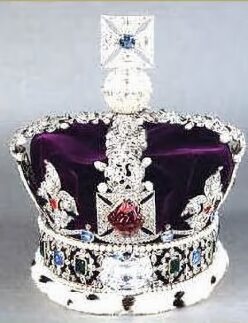
The Imperial Crown of State also contains pearls worn as earrings by Elizabeth I, these are suspended from the arches of the crown. Within the wide jewel encrusted band that forms the base of the Crown of State is mounted an enormous diamond, named the Second Star of Africa. This was cut from the famous Cullinan Diamond, the largest diamond ever mined, it was given to Edward VII, who had it set in the crown. This priceless crown contains in all 2,783 diamonds, 17 sapphires , 277 pearls, 11, emeralds and 5 rubies.
The Stewart Sapphire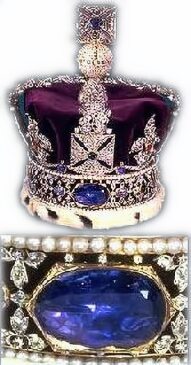
The Stewart Sapphire, which had been owned by the Royal House of Scotland for centuries, was also given to George III. The original owner of the sapphire was reputed to have been King Alexander II of Scotland, who had it set into his crown for his coronation in 1214. Edward I of England took the sapphire along with the Stone of Scone in 1296, during his invasion of Scotland. His grandson, King Edward III, later returned the jewel to his brother-in-law David II of Scotland. King David II presented the sapphire to his sister, Marjorie Bruce. Marjorie later married Walter the Steward, her son was Robert II, the first monarch of the House of Stewart. On the accession of James I and VI, the sapphire returned once again to England.
Oliver Cromwell sold the jewel along with the rest of the British Crown Jewels, during the Interregnum. After the Restoration, the sapphire was returned to Charles II. The sapphire is recorded as being part of the Stewart relics taken by James II to his exile in France when he fled the country on the invasion of William of Orange. After James' death, it passed to his son, James Francis Edward Stuart, the 'Old Pretender, who gave it to his second son Henry Benedict, Cardinal York.
In 1838 the young Queen Victoria had the jewel set into the new Imperial State Crown, it was positioned at the front, below the Black Prince's Ruby. When George VI had a new Imperial State Crown made, which was almost identical to the old one, the Stewart Sapphire was set in the new crown. On the acquisition of the Cullinan diamonds, the Stewart Sapphire was moved to the rear of the crown to make space for the cushion-shaped Cullinan II. Black Prince's Ruby
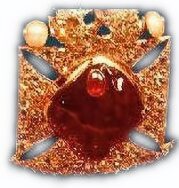
The Black Prince's Ruby, which now forms part of the crown jewels, was presented to Edward, the Black Prince by Pedro the Cruel of Castile, in reward for Edward's putting down the revolt of Pedro's illegitimate brother, Henry of Trastamara.
The ruby has a long and fascinating history, possibly originating from the historic ruby mines in Badakshan in present day Tajikistan, in the middle of the fourteenth century it was in the possession of Abu Sa'id, the Moorish Prince of Granada.
At that time, the rule of Castilian Spain was being centralized to Seville and the Moorish Kingdom of Granada was being systematically attacked and reverted to Spanish rule as a part of the Christian Reconquest of Spain. According to historical accounts, Abu Sa'id wished to surrender to Don Pedro, but the conditions he offered were unclear. Don Pedro welcomed his coming to Seville and when the pair met, Don Pedro, had Abu Sai'd's servants slain and may have personally stabbed Said to death himself. Upon searching Said's body, the ruby was found and taken by Don Pedro.
During his French campaigns, King Henry V wore a gem-encrusted helmet that included the ruby, which was worn at the Battle of Agincourt on October 25, 1415, Richard III is reported to have also worn the Black Prince's Ruby in his helmet at the Battle of Bosworth Field in 1485. James, I had the Black Prince's Ruby set into the state crown near the beginning of the seventeenth century. During the Interregnum, it was sold by Oliver Cromwell. The Black Prince's Ruby was purchased by a British jeweller who sold it back to the crown of Charles II when the monarchy was restored in 1660. It is currently set in the cross pattée above the Cullinan II Diamond in front of the Imperial State Crown.
St. Edward's Sapphire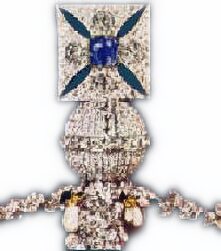
St. Edward's Sappphire, the most ancient gemstone in the crown jewels, was once worn in a ring by Edward the Confessor, first recorded in the year 1042 when it was set into Edward's coronation ring. It was buried with him in 1066 but in 1101 his shrine was opened, the ring was removed and the Sapphire was re-set in a crown worn by Henry I.
It was then re-cut into its present form for Charles II and Queen Victoria later had it set into the cross of the Imperial State Crown, part of the British Crown Jewels.
According to legend, King Edward who had great respect for John the Evangelist and was noted for his generosity towards his poorer subjects was approached by a beggar one day whilst on his way to Westminster Abbey. After searching his pockets for some money, the King found them to be empty so he slipped the Sapphire ring off his finger and gave it to the beggar. Many years later, two pilgrims from the Holy Land returned it to the king saying they had met St John the Evangelist who told them he had been given the ring by the king many years earlier whilst disguised as a beggar. He congratulated Edward for his kindness and said he would see him in heaven in six months. Exactly six months later the king died.
The sapphire is a rose cut blue gemstone of unknown weight, with exceptional colour and brilliance. It is set in a Maltese cross at the top of the crown.
The sovereign is always crowned with St. Edward's crown. This is a golden crown encrusted with diamonds, rubies, pearls, emeralds and sapphires. It replaced the one destroyed by Cromwell.
Edwards Crown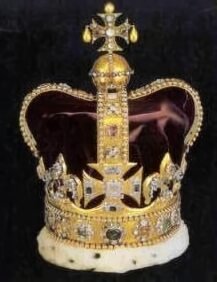
The crown has been used in the coronation of every British monarch since Queen Victoria, by whom it was considered too heavy, she was crowned with the lighter State Crown.
One of the most impressive of the crowns on display at the Tower of London is the crown made for Queen Elizabeth, the Queen Mother. This contains the legendary Koh-i-Noor or Mountain of Light diamond. Indian in origin, its history can be traced to the thirteenth century. It was presented to Queen Victoria by the East India Company in 1850. A legend clings to it that it brings good luck to any woman that wears it, but disaster to any man and many of the men that have owned it have met a violent end.
Crown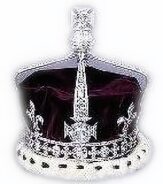
The Imperial Crown of India was made for the visit of King George V to Delhi as Emperor of India. It is set with more than 6,000 diamonds with rubies, sapphires and emeralds.
The George IV State Diadem was made for the coronation of George IV in 1820, designed to encircle the velvet cap worn by the king on his journey to Westminster Abbey.
The diadem was worn by Queen Victoria at her coronation when it was reset with jewels to replace those hired by George IV. It is composed of four diamond pave set cross pattee alternating with four bouquets of rose, shamrock and thistle. The front cross pattee is set with a four-carat canary coloured diamond. It was left by Queen Victoria in her will to the crown and is often worn by the present queen at the State Opening of Parliament.
The largest cut diamond in the world is contained in the Royal Sceptre with the Cross. Made of gold and three feet in length, it also contains an enormous amethyst and a superb emerald. There are several other sceptres contained in the Crown Jewels.
The Orb, a golden globe topped by a diamond-encrusted cross dates to 1661 for the coronation of Charles II and is symbolic of the world ruled by Christianity, it is held in the monarch's left hand during the coronation ceremony. The jewelled cross which surmounts the orb reflects the monarch's title of Defender of the Faith.
The orb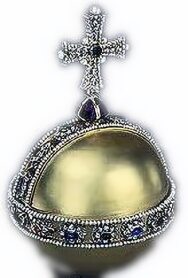
A smaller orb was made in 1689 for the joint coronation of William III and Mary II.
The jewels additionally contain five Swords of State, three of which are the Great Sword of State, the Sword of Justice and the Sword of Mercy, all of which are used in the coronation ceremony. They are traditionally carried before the monarch as he/she enters Westminster Abbey.
The Armills are gold bracelets that are meant to symbolize sincerity and wisdom
There are also maces, a Queen's orb, sixteen silver state trumpets and a variety of banqueting plate used in the coronation ceremony, which also forms part of this priceless and unique collection.


