King of England
The charismatic Edward III, one of the most dominant personalities of his age, was the son of Edward II and Isabella of France. He was born at Windsor Castle on 13th of November, 1312 and created Earl of Chester at four days old.
Edward was aged fourteen at his ill-fated father's abdication, he had accompanied his mother to France where she and her lover, Roger Mortimer, Earl of March, planned his father's overthrow. Edward II was later probably murdered at Berkeley Castle, however, there are conflicting theories, all of which lack concrete proof as to how the ex-king met with his untimely end. Although nominally King, the young Edward III was in reality the puppet of Mortimer and his mother, who ruled England through him. Edward III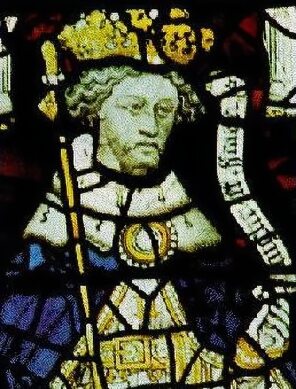
A handsome and approachable youth, whom Thomas Walsingham described as "a shapely man, of stature neither tall nor short, his countenance was kindly." Edward drew inspiration from the popular contemporary tales of chivalry.
He was married to his cousin, Phillipa of Hainault, the daughter of William the Good, Count of Hainault and Holland and Jeanne of Valois, granddaughter of Phillip III of France. The marriage had been negotiated by Edward's mother, Isabella, in the summer of 1326.
Isabella, who was estranged from her husband, Edward II, visited the Hainaut court, along with Prince Edward, to obtain aid from Count William to depose King Edward in return for the couple's betrothal. After a dispensation had been obtained for the marriage of the cousins (they were both descendants of Philip III), Philippa arrived in England in December 1327 escorted by her uncle, John of Hainaut. The marriage celebrated at York Minster on 24th January 1328, was a happy one, the two became very close and produced a large family. A description of Phillipa as a child survives, written by Bishop Stapledon of Exeter for King Edward II:-
Phillipa of Hainault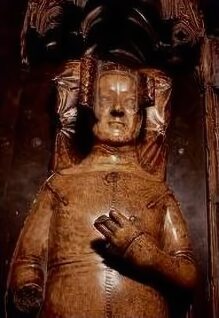
The lady whom we saw has not uncomely hair, betwixt blue-black and brown. Her head is clean-shaped; her forehead high and broad, and standing somewhat forward. Her face narrows between the eyes, and the lower part of her face is still more narrow and slender than the forehead. Her eyes are blackish-brown and deep. Her nose is fairly smooth and even, save that it is somewhat broad at the tip and somewhat flattened, yet it is no snub nose. Her nostrils are also broad, her mouth fairly wide. Her lips somewhat full, and especially the lower lip. Her teeth which are fallen and grown again are white enough, but the rest are not so white. The lower teeth project a little beyond the upper, yet this is but little seen. Her ears and chin are comely enough. Her neck, shoulders, and all her body and lower limbs are reasonably well-shaped; all her limbs are well set and unmaimed; and nought is amiss so far as a man may see. Moreover, she is brown of skin all over, and much like her father; and in all things she is pleasant enough, as it seems to us. And the damsel will be of the age of nine years on St John's day next to come, as her mother saith. She is neither too tall nor too short for such an age; she is of fair carriage."
Phillipa was kind and inclined to be generous and exercised a steadying influence on her husband. Their eldest son Edward, later known as the Black Prince, was born on 15th June 1330, when his father was eighteen. Phillipa of Hainault was a popular Queen Consort, who was widely loved and respected, and theirs was a very close marriage, despite Edward's frequent infidelities. She often acted as Regent in England during Edward's absences in France. Froissart describes her as being "tall and upright, wise, gay, humble, pious, liberal and courteous."
Edward III and Edward, the Black Prince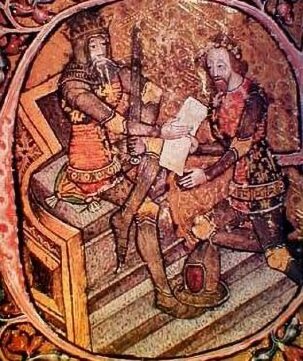
Edward and Phillipa produced fourteen children in all. Their eldest child, Edward the Black Prince was born on 15 June 1330 at the Royal Palace of Woodstock in Oxfordshire. Their second child, a daughter, was born at Woodstock on June 16, 1332, and named Isabella after her paternal grandmother. Isabella was her father's favourite daughter he was said to have doted on her. A second daughter, Joan, named after Phillipa's mother, was born in the Tower of London in late 1333 or early 1334. A son William was born at Hatfield on 16 February 1337 but survived only a few months. In 1338, Philippa and Edward travelled to Europe to arrange alliances in support of Edward's claim to the French throne. Philippa stayed in Antwerp, where her son, Lionel, later Duke of Clarence, was born on November 29, 1338. He was to grow to be nearly seven feet tall. Philippa gave birth to another son John of Gaunt, later Duke of Lancaster, on March 6, 1340, at Ghent. A further son, Edmund, who would be created Duke of York, was born at Langley in June of 1341. In 1343, Phillipa gave birth to a daughter Blanche who died soon after she was born. On October 10, 1344, she gave birth to a daughter named Mary, another daughter, Margaret, was born in 1346. William was born at Windsor in 1347. Their last child, Thomas was born at Woodstock in 1355.
Personal Rule
It seems Edward had been fond of his father Edward II. By the Autumn of 1330, when he reached eighteen, he strongly resented his political position and Mortimer's interference in government. Aided by his cousin, Henry, Earl of Lancaster and several of his lords, Edward led a coup d'etat to remove Mortimer from power. The Dowager Queen's lover was arrested at Nottingham Castle. Stripped of his land and titles, Mortimer was accused of assuming Royal authority. Isabella's pleas for her son to show mercy were ignored. Without the benefit of a trial, Mortimer was sentenced to death and executed at Tyburn. Isabella herself was shut up at Castle Rising in Norfolk, where she could meddle in affairs of state no more, but she was granted an ample allowance and permitted to live in comfort. Troubled in his conscience about the part he had been made to play in his father's downfall, Edward built an impressive monument over his father's burial place at Gloucester Cathedral.
Edward renewed his grandfather, Edward I's war with Scotland and repudiated the Treaty of Northampton, which had been negotiated during the regency of his mother and Roger Mortimer. This resulted in the Second War of Scottish Independence. he regained the border town of Berwick and won a decisive victory over the Scots at Halidon Hill in 1333, placing Edward Balliol on the throne of Scotland. By 1337, however, most of Scotland had been recovered by David II, the son of Robert the Bruce, leaving only a few castles in English hands
The Houses of Plantagenet and Valois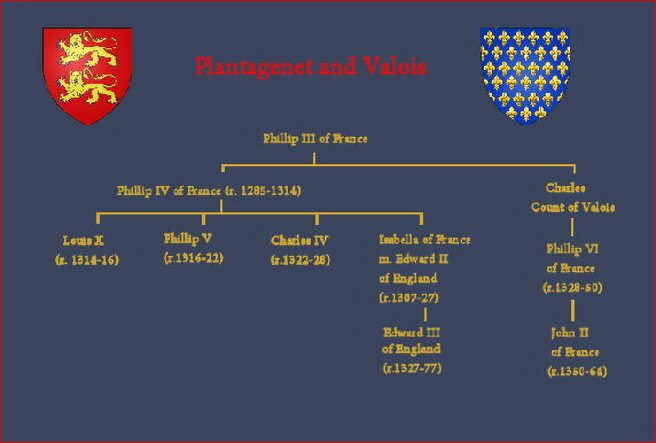
The Hundred Years War
The Capetian dynasty of France, from whom King Edward III descended through his mother, Isabella of France, (the daughter of Phillip IV, 'the Fair') became extinct in the male line. The French succession was governed by the Salic Law, which prohibited inheritance through a female.
Edward's maternal grandfather, Phillip IV died in 1314 and was succeeded by his three sons Louis X, Philip V, and Charles IV in succession. The eldest of these, Louis X, died in 1316, leaving only his posthumous son John, who was born and died that same year, and a daughter Joan, whose paternity was suspect. On the death of the youngest of Phillip's sons, Charles IV, the French throne, therefore, descended to the Capetian Charles IV's Valois cousin, who then became Phillip VI.
As the grandson and nephew of the last Capetian kings, Edward considered himself to be a far nearer relative than a cousin. He quartered the lilies of France with the lions of England in his coat-of-arms and formally claimed the French throne through the right of his mother. By doing so Edward began what later came to be known as the Hundred Years War. The conflict was to last for 116 years from 1337 to 1453.
The French were utterly defeated in a naval battle at Sluys on 24th June 1340, which safeguarded England's trade routes to Flanders. This was followed up by an extraordinary land victory over Phillip VI at Crécy-en-Ponthieu, a small town in Picardy about mid-way between Paris and Calais. The Battle of Crecy was fought on 26th August 1346, where a heavily outnumbered English army of around 15,000, defeated a French force estimated to number around 30,000 to 40,000. French losses were enormous and it was at Crecy that the King's eldest son, Edward, Prince of Wales, otherwise known as the Black Prince, so named for the colour of his armour, famously won his spurs.
Edward then laid siege to the port of Calais in September, which, after a long-drawn-out siege, eventually fell into English hands in the following August. Edward was determined to make an example of the unfortunate burghers of Calais, but the gentle Queen Phillipa, heavily pregnant, interceded with her husband, pleading for their lives. Calais was to remain in English hands for over two hundred years, until it was lost to the French in 1558, during the reign of the Tudor queen, Mary I.
The war with Scotland was resumed. Robert the Bruce was long dead, but his successor, David II, seized the chance to attack England while Edward III's attention was engaged in France. The Scots were defeated at The Battle of Neville's Cross by a force led by William Zouche, Archbishop of York, Henry Percy and Ralph Neville. The Scot's king, David II, was taken prisoner to England, where he was housed in the Tower of London. After spending eleven years prisoner in England, he was released and allowed to return to Scotland for the huge ransom of 100,000 marks.
The Black Prince covered himself in glory when he vanquished the French yet again at Poitiers in 1356, where the French king, John II, was captured. A ransom was demanded for his return which amounted to the equivalent of twice the country's yearly income. King John was accorded royal privileges whilst a prisoner of the English and was allowed to return to France in an attempt to collect a huge ransom. Claiming to be unable to raise the amount, he voluntarily re-submitted himself to English custody and died a few months later. Peace was then negotiated and by the Treaty of Bretigny of 1360 England retained the whole of Aquitaine, Ponthieu and Calais, in return Edward relinquished his claim to the French throne.
The sword of Edward III
The great two-handed iron sword of King Edward III still survives to the present day in the royal collection.
The sword of Edward III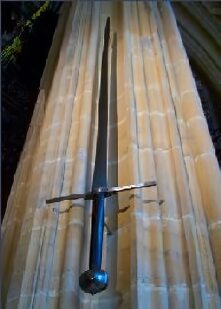
The sword can be seen in St. George's Chapel, Windsor Castle, the mother chapel of the Order of the Garter, displayed on a pillar in the South Quire Aisle, where it has hung for the past four hundred years. The sword hangs by a portrait of the king depicted with the crowns of England, Scotland and France.
Measuring 6 foot 8 inches in length and made to be carried into battle, the sword formed part of the knightly achievements which were offered to the Dean and Canons on the king's death.
Edward III was responsible for founding England's most famous order of chivalry, the Order of the Garter. Legend states that while dancing with the King at a ball, a Lady (said by some sources to be the Countess of Shrewsbury) was embarrassed to have dropped her garter. The King chivalrously retrieved it for her, picking it up, he tied it around his leg, gallantly stating "Honi soit qui mal y pense."(evil to him who evil thinks). This became the motto of the order, a society of gartered knights based at St.George's Hall, Windsor Castle.
The earliest record of the sword appears in an Inventory of all the Vestments, Ornaments etc of the Chapel, taken in the eighth year of the reign of his grandson and successor King Richard II.
Edward III in later years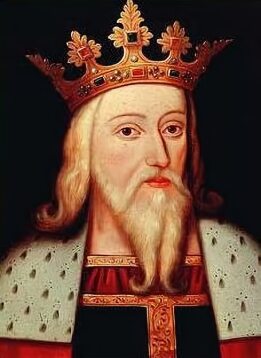
The Black Death
Edward IIIDisaster struck England in Edward III's reign, in the form of bubonic plague, or the Black Death, which cut a scythe across Europe in the fourteenth century, killing a third of it's population. It first reached England in 1348 and spread rapidly. In most cases the plague was lethal. Infected persons developed black swellings in the armpit and groin, these were followed by black blotches on the skin, caused by internal bleeding. These symptoms were accompanied by fever and spitting of blood. Contemporary medicine was useless in the face of bubonic plague, it's remorseless advance struck terror into the hearts of the medieval population of Europe, many in that superstitious age saw it as the vengeance of God. The population of England was decimated.
Three of Edward's children, his daughter Joan and young sons, Thomas and William, who had been born in 1347 and 1348, were to die during the outbreak of bubonic plague in 1348. Joan was betrothed to Peter of Castile, son of Alfonso XI of Castile in 1345, and left England to journey to Castile in the summer of 1348. She stayed at the city of Bordeaux, in southern France, en-route, where there was a severe outbreak of the plague. Members of her entourage began to fall sick and die and Joan was moved, probably to the small village of Loremo, where she succumbed to the Black Death, suffering a violent attack she died on September 2, 1348. Edward wrote mournfully to Alphonso XI of Castille:-
"We are sure that your Magnificence knows how, after much complicated negotiation about the intended marriage of the renowned Prince Pedro, your eldest son, and our most beloved daughter Joan, which was designed to nurture perpetual peace and create an indissoluble union between our Royal Houses, we sent our said daughter to Bordeaux, en route for your territories in Spain. But see, with what intense bitterness of heart we have to tell you this, destructive Death (who seizes young and old alike, sparing no one and reducing rich and poor to the same level) has lamentably snatched from both of us our dearest daughter, whom we loved best of all, as her virtues demanded. No fellow human being could be surprised if we were inwardly desolated by the sting of this bitter grief, for we are humans too. But we, who have placed our trust in God and our Life between his hands, where he has held it closely through many great dangers, we give thanks to him that one of our own family, free of all stain, whom we have loved with our life, has been sent ahead to Heaven to reign among the choirs of virgins, where she can gladly intercede for our offenses before God Himself"
In the aftermath of the Black Death, there was inevitable social upheaval. Parliament attempted to legislate on the problem by introducing the Statute of Laborers in 1351, which attempted to fix prices and wages.
The Death of Edward III
Queen Phillipa died in August 1369, of an illness similar to dropsy. The last years of Edward III's reign saw him degenerate to become a pale shadow of the ostentatious and debonair young man who had first set foot in France to claim its throne.
The King began to lean heavily on his grasping and avaricious mistress, Alice Perrers, who had served as a lady-in-waiting to Queen Philippa. Possibly the daughter of a prominent Hertfordshire landowner, Sir Richard Perrers, she became his mistress in 1363, when she was 15 years of age, six years before the queen's death. After the Queen's death, Edward lavished gifts on her, she was given property and even some of the late Queen Phillipa's jewels and robes.
Alice Perrers gave birth to three illegitimate children by Edward III, a son named Sir John de Southeray (c. 1364-1383), who married Maud Percy, daughter of Henry Percy, 3rd Baron Percy, and two daughters, Jane, who married Richard Northland, and Joan, who married Robert Skerne.
Edward III tomb effigy, Westminster Abbey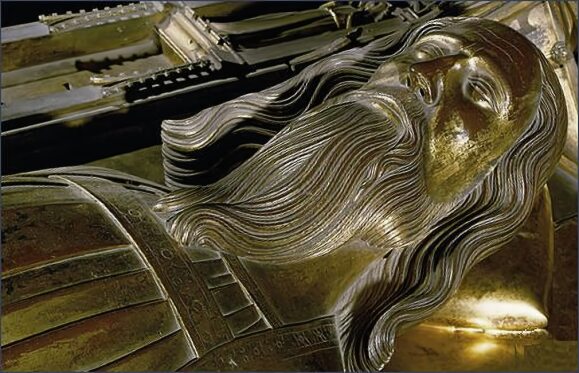
The Black Prince and Edward's ambitious third son John of Gaunt, Duke of Lancaster, became the leaders of divided parties in the court and the king's council. With the help of Alice Perrers, John of Gaunt obtained influence over his father, and controlled the government of the kingdom.
His heir, Edward, the Black Prince, the flower of English chivalry, was stricken with illness and died before his father in June 1376. The chronicler Rafael Holinshed, tells us Edward believed the early death of his son was God's punishment for usurping his father's crown:-"But finally the thing that most grieved him, was the loss of that most noble gentleman, his dear son Prince Edward . . . But this and other mishaps that chanced to him now in his old years might seem to come to pass for a revenge of his disobedience showed to his in usurping against him."
In September 1376 the king was unwell and was said to be suffering from an abscess. He made a brief recovery but, in a fragile condition, suffered a stroke at Sheen on 12th June 1377. It was said that Alice Perrers stripped the rings from his fingers before he was even cold.
Edward III was buried in Westminster Abbey, the gilt-bonze effigy of the king lies on top of a tomb chest with six niches along each long side holding miniature effigies of the kings twelve children. The wooden funeral effigy of Edward III, modelled from a death mask, survives at Westminster Abbey and has a twisted mouth, which suggests the effects of a stroke on the ageing king.
Edward was succeeded by his grandson, Richard II, the eldest surviving son of the Black Prince.
Edward the Black Prince
St. George's Chapel, Windsor - Chapel of the Order of the Garter
The International Ancestry of Edward III
Edward III
Father: Edward II of England
Paternal Grandfather: Edward I of England
Paternal Great-grandfather: Henry III of England
Paternal Great-grandmother: Eleanor of Provence
Paternal Grandmother: Eleanor of Castille
Paternal Great-grandfather: Ferdinand III of Castille
Paternal Great-grandmother: Jeanne of Dammartin
Mother: Isabella of France
Maternal Grandfather: Phillip IV of France
Maternal Great-grandfather: Phillip III of France
Maternal Great-grandmother: Isabella of Aragon
Maternal Grandmother: Joan I of Navarre
Maternal Great-grandfather: Henry I of Navarre
Maternal Great-grandmother: Blanche of Artois
The Children and Grandchildren of Edward III and Phillipa of Hainault
(1) Edward of Woodstock, Prince of Wales, The Black Prince, (1330-76) m. Joan Plantagenet, Countess of Kent.
Issue :-
(i) Edward of Angouleme (1365-72)
(ii) RICHARD II (1367-1400) m. (1) Anne of Bohemia (no issue) (2) Isabelle of France(no issue)
(2) Isabella (1332- 1382) m. Enguerrand de Coucy, Seigneur de Coucy, Earl of Bedford.
issue:-
(i) Marie de Coucy (1367-1405) m.Henry de Bar, Seigneur de Oisy
(ii) Phillipa de Coucy (d.1411) m. Robert de Vere, Earl of Oxford.
(3) Princess Joan of England or 'of the Tower' (1335-1348) no issue
(4) Prince William of Hatfield b. 1337 died in infancy (1337)
(5) Lionel of Antwerp, Duke of Clarence (1338-1368) m. (1) Elizabeth de Burgh, Countess of Ulster. (2) Violante Visconti.
Issue (by 1) :-
(i) Phillipa Plantagenet, Countess of Ulster (1355-78) m. Edmund Mortimer, Earl of March. From this marriage descended the House of York.
(6) John of Gaunt, Duke of Lancaster and Aquitaine, Earl of Richmond.(1340-99) m. (1) Blanche Plantagenet (2) Constance of Castille (3) Katherine Swynford.
Issue by (1) :-
(i) John, Earl of Richmond. (b.1362) died in infancy
(ii) Edward. ( b. 1365) died in infancy
(iii) John (b. 1366) died in infancy
(iv) HENRY IV (1367-1413) m. (1) Mary de Bohun, Countess of Hereford. (2)
Joan of Navarre from the first marriage descended the House of Lancaster.
(v) Phillipa of Lancaster (1360-1415) m. John I, King of Portugal
(vi) Elizabeth of Lancaster (1365-1425) m. (1) John Hastings, Earl of Pembroke (2)
John Holland, Duke of Exeter (3) Sir John Cornwall.
Issue by (2) :-
(vii) Isabel of Lancaster (b. 1368) died in infancy
(viii) Catherine of Lancaster (1372-1458) m. King Henry III of Castille and Leon
Issue by (3):-
(ix) John Beaufort, Marquess of Dorset and Somerset (1373-1410) m. Hon. Margaret
Beauchamp of Bletso
(x) Henry Beaufort, Cardinal (1375-1417)
(xi) Thomas Beaufort, Earl of Dorset (1377-1426) m. Margaret Neville
(xii) Joan Beaufort (1379-1440) m. (1) Robert Ferrers, Baron Ferrers (2)
Ralph Neville, Earl of Westmorland
(7) Edmund of Langley, Earl of Cambridge, Duke of York (1341-1402) m.(1) Isabel of Castille and Leon (2) Joan Holland
Issue by (1 ):-
(i) Edward Plantagenet, Earl of Rutland, Duke of York and Albemarle
(1373-1415) m. Hon Phillipa de Mohun
(ii) Richard Plantagenet, Earl of Cambridge (1374-1416) m. (1) Lady Anne Mortimer (2) Hon. Maud Clifford
(iii) Constance Plantagenet (1374-1416) m. Thomas le Despencer, Earl of Gloucester
(8) Blanche Plantagenet (b. 1342) died in infancy (1342)
(9) Mary Plantagenet (1334-1362) m. John V, Duke of Brittany
(10) Margaret Plantagenet (1346-1361) m, John Hastings, Earl of Pembroke
(11) Thomas of Woodstock, Earl of Buckingham, Duke of Gloucester (1335-97) m. Eleanor de Bohun.
Issue:-
(i) Humphrey, Duke of Gloucester (1382-99)
(ii) Anne Plantagenet (1383-1438) m, (1)Thomas Stafford, Earl of Stafford (2) Edmund Stafford, Earl of Stafford
(3) Sir William Bourchier


Edward II PreviousNext Richard II