Arthur, Prince of Wales
Henry had been haggling with Ferdinand and Isabella for some time regarding the terms of the arranged marriage between his son Arthur and their daughter Katherine of Aragon. The main bones of contention being the dowry she would receive and the two fathers deep distrust of each other, based on previous experience. A final marriage treaty was arrived at in October 1496, after which a proxy marriage took place.
Henry VII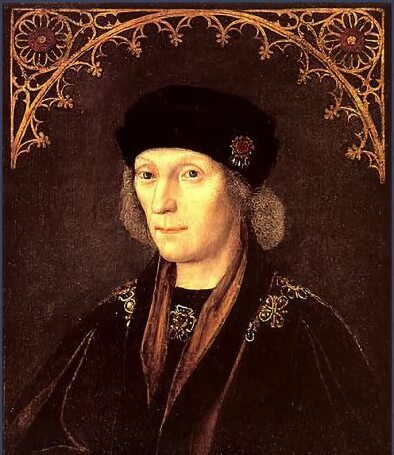
Ferdinand and Isabella raised their fears about sending their daughter to England before the Tudor dynasty was secured by the removal of rival claimants to the throne. Due to his Yorkist descent, Edward, Earl of Warwick, the son of George Duke of Clarence, posed the largest threat to the Tudor claim to the throne.
A plot was hatched whereby an escape attempt would be engineered involving Warwick and Warbeck, who would then be hastily recaptured. This resulted in Warbeck being hanged at Tyburn and Warwick beheaded. Warwick, believed to have been mentally retarded, (his sister later said 'he did not know a goose from a capon'), was held prisoner all his short life for being who he was and died because he tried to escape.
Catherine of Aragon was sent to England in 1501 and received in her new country with much rejoicing. The royal family waited to receive her in London, Henry, still fearing he had been deceived in some way by the cunning Ferdinand and suspecting that Arthur's bride could be ugly or even worse, deformed, could contain his anxiety no longer and rode with Arthur to see her at Basingstoke. Catherine was a sweet-faced, pretty girl with attractive red-gold hair. A pleasant interlude took place, where Catherine danced some of her native Spanish dances for the King and her future husband, who then departed well satisfied. Henry wrote to her parents that he 'much admired her beauty as well as her agreeable and dignified manner.'
Arthur and Catherine were married at St. Paul's Cathedral, the bride was given away by Arthur's ebullient ten-year-old brother, Henry, Duke of York. There were feasts, jousts and disguisings to celebrate the event. Even the parsimonious Henry, always inclined to be very frugal with money, spent lavishly on the celebrations. The 'upstart' Tudor dynasty gained much in prestige from its new-forged links with the powerful House of Trastamara.
Catherine of Aragon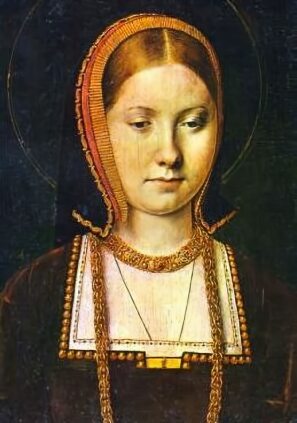
Arthur and Catherine where sent to Ludlow, on the Welsh Marches, traditionally the seat of the Prince of Wales. During the spring, an epidemic of sweating sickness was rife in the area and both Arthur and Catherine contracted it. Catherine recovered, but Arthur, a pale thin youth who had never enjoyed robust health, did not and died at Ludlow Castle.
The Death of Elizabeth of York
Henry and Elizabeth were prostrate with grief at the loss of their eldest son and heir and attempted to comfort each other. The survival of the dynasty they had founded now rested on their one surviving son, Prince Henry.
The grieving parents decided to try for another son to secure the succession in the Tudor line. Elizabeth quickly became pregnant. The pregnancy affected her health and she was unwell throughout it. Nine days after giving birth to a daughter, Catherine, she died in the Tower of London, on 11th February 1503, dying of a post-pregnancy infection on her 37th birthday. The child lived only a day. Henry VII gave his wife a magnificent funeral, Elizabeth was buried at Westminster Abbey in the ornate Henry VII chapel which her husband was building. The young Sir Thomas More wrote an elegiac poem in her memory.
Margaret Tudor
The King's elder daughter Margaret Tudor was married to James IV, King of Scots, to seal an alliance with Scotland. Scotland and England concluded the Treaty of Perpetual Peace, the first peace agreement between the two realms in over 170 years. Even before Margaret's sixth birthday, Henry had considered a marriage between Margaret and James IV as a means of ending James' support for the Yorkist pretender Perkin Warbeck, Henry escorted his daughter part of the way north, calling en-route to see his aged mother, Margaret Beaufort, at her home in Collyweston, Northamptonshire. It was through this marriage that the Scottish Stuart dynasty was eventually to inherit England's throne.
Tomb of Henry VII and Elizabeth of York, Westminster Abbey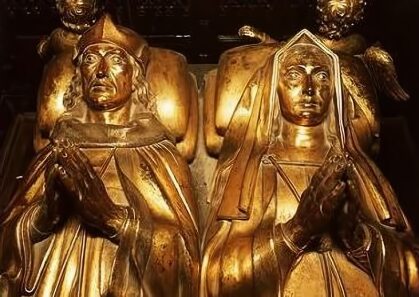
The later years
New disputes arose between Henry VII and Ferdinand of Aragon, who still could not bring themselves to trust each other. Since his daughter was now widowed, Ferdinand wished to be reimbursed for the first instalment of her dowry. Henry, on the other hand, having got the money, was singularly inclined not to part with it and inflamed the situation further by promptly demanding the rest of it.
Henry suggested that he should marry Catherine himself. This proposal met with an icy response from Isabella, 'It would be an evil thing,' she wrote 'the mere mention of which offends the ears'. Agreement was finally reached that Catherine should marry the young Henry, the new heir to the throne. Even this arrangement did not run smoothly, Henry and Ferdinand continued to haggle endlessly about money.
Catherine was forced to live in near penury with a frugal allowance from her father-in-law. Henry at one point instructed his son to repudiate his betrothed and embarked on a series of alternative negotiations with the Habsburgs. This resulted in his younger daughter Mary being betrothed to the Habsburg heir, the ugly and highly inbred, Charles V.
After the death of Elizabeth of York, Henry became somewhat reclusive and even more avaricious. He entertained the idea of marrying Catherine's mentally deranged sister, Joanna, who since the death of their elder sister, was heiress to her mother's kingdom of Castille.
Henry VII died on 21st April 1509 of tuberculosis at the age of 52 and was buried at Westminster beside Elizabeth of York. Their magnificent effigies, provided by his son, Henry VIII and that of Henry's mother, Margaret Beaufort, (who followed him to the grave but a few months later) by the Renaissance sculptor Pietro Torrigiano can still be seen in the Henry VII chapel at Westminster Abbey.
The family of Elizabeth of York and Henry VII
The marriage of Elizabeth of York and Henry Tudor was to produce 7 children, of which only 4 survived the perils of infancy in Tudor times:-
Arthur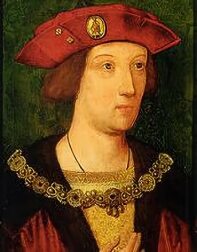
*Arthur, Prince of Wales (September 20, 1486 - April 2, 1502) m. Katherine of Aragon
Arthur predeceased his father, Henry VII, he died suddenly at the early age of 15, of the sweating sickness, at Ludlow Castle in the Welsh Marches soon after his marriage to Katherine of Aragon, and is buried at Worcester Cathedral.
There was no issue from the marriage.
Margaret Tudor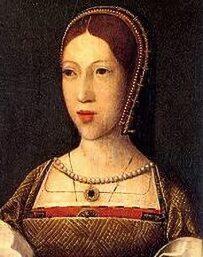
*Margaret Tudor, (November 28, 1489 - October 18, 1541) m. (1) James IV, King of Scots (2) Archibald Douglas, Earl of Angus (3) Henry Stewart, Lord Methven.
Issue by (1):-
(i)James Stewart, Duke of Rothesay (1507 - 1508)
(ii)Arthur Stewart, Duke of Rothesay (1509 - 1510)
(iil)JAMES V, King of Scots (1512 -1542) - the father of Mary Queen of Scots
(iv)Alexander Stewart, Duke of Ross (1514 - 1515)
Issue by (2):-
(v)Lady Margaret Douglas (1515 -1578) - the mother of Henry Stuart Lord Darnley, husband of Mary, Queen of Scots
Mary, Queen of Scots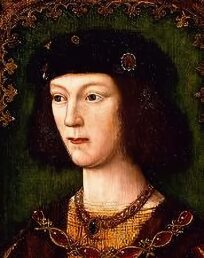
*HENRY VIII (June 28, 1491 - January 28, 1547). m.(1)Katherine of Aragon (2)Anne Boleyn (3)Jane Seymour (4)Anne of Cleves (5)Katherine Howard (6)Catherine Parr
Issue:-By Catherine of Aragon-
Henry Tudor, Duke of Cornwall (b. & died 1511)
MARY I (1516-1558) m. Phillip II of Spain
By Anne Boleyn-
ELIZABETH I (1533 -1603)
By Jane Seymour-
EDWARD VI (1537 -1553)
*Elizabeth Tudor (July 2, 1492 - September 14, 1495).
Elizabeth Tudor died of atrophy, around six months before the birth of her sister Mary. She was buried in Westminster Abbey.
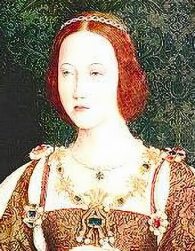
*Mary Tudor (March 18, 1496 - June 25, 1533). m.(1)Louis XII, King of France (2)Charles Brandon, Duke of Suffolk
Issue (by 2):-
Henry Brandon, Earl of Lincoln (1516 -1534) - created Earl of Lincoln by Henry VIII on 18 June 1525 at the age of only two, Henry died at the age of ten or eleven.
Lady Frances Brandon (1517 -1559) married (1) Henry Grey, Duke of Suffolk (2) Adrian Stokes -the mother of Lady Jane Grey the nine days Queen, who was executed in the reign of Mary I.
Lady Eleanor Brandon (d.1547) m. Henry Clifford, Earl of Cumberland
Edmund Tudor, Duke of Somerset (February 21, 1499 - June 19, 1500).
Edmund Tudor died at 15 months of unknown causes, and was buried at Westminster Abbey.
*Katherine Tudor (born & died February, 1503).
Katherine Tudor died a few days after her birth.
The Ancestry of Henry VII
Henry VII
Father: Edmund Tudor, Earl of Richmond
Paternal Grandfather: Owen Tudor
Paternal Great-grandfather: Meredith ap Tudor
Paternal Great-grandmother: Margaret verch Dafydd
Paternal Grandmother: Catherine of Valois
Paternal Great-grandfather: Charles VI of France
Paternal Great-grandmother: Isabeau of Bavaria
Mother: Margaret Beaufort
Maternal Grandfather: John Beaufort, Duke of Somerset
Maternal Great-grandfather: John Beaufort, Earl of Somerset
Maternal Great-grandmother: Margaret Holland
Maternal Grandmother: Margaret Beauchamp of Bletso
Maternal Great-grandfather: John, Baron Beauchamp of Bletso
Maternal Great-grandmother: Edith Stourton


Edward Courtenay PreviousNext Henry VIII