1603-1625. Early Years
England's first Stuart monarch, James I & VI, the son of that ill-matched pair, Mary, Queen of Scots and Henry Stuart, Lord Darnley, was born at Edinburgh Castle after a difficult and protracted labour on 19th June 1566. Elizabeth I stood as godmother by proxy at his Catholic baptism when he was given the names James Charles. The domestic situation he was born into was a fractious one. By the time of James' birth, his parent's relationship was already failing. The Queen of Scots deeply regretted her impulsive second marriage and loathed her self-seeking, foolish and arrogant spouse. James I and VI as a child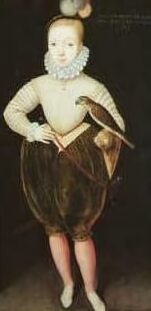
Desperate to be rid of Darnley, but not prepared to hazard the legitimacy of her child by annulment of the marriage, Mary entered into a plot with James Hepburn, Earl of Bothwell, to kill her husband. Darnley was found dead on the grounds of a house in Kirk o' Field, Edinburgh on 10th February 1567, having escaped the initial blast of gunpowder that had been used to blow up the building, he and his servant were found to have been strangled in the grounds.
Mary later outraged her subjects and incited rebellion when she hastened to marry Bothwell, believed by many to be the murderer of her husband. She was deposed in favour of the infant James and imprisoned at Lochleven Castle. On her escape, she fled to England, where Elizabeth I deemed it wise to keep her cousin in lifelong captivity. James became King of Scots at thirteen months old, he was never again to see his mother and can have had no memory of her.
James I and VI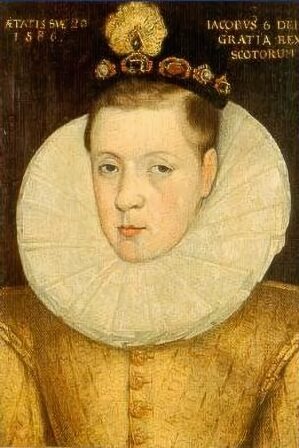
James VI, King of Scots
James inherited nothing of his mother's legendary Stewart charm. He had a strict Scots Calvinist upbringing and was given a rigorous programme of education by his tutors, displaying a marked precocity and intelligence from an early age. His care was entrusted to the Earl and Countess of Mar, "to be conserved, nursed, and upbrought" in security of Stirling Castle. He was crowned King of Scots at the age of thirteen months at the Church of the Holy Rude, Stirling, by Adam Bothwell, Bishop of Orkney, on 29 July 1567.
During the troubled years of James' minority, four successive regents ruled Scotland. His first regent was his mother's bastard half-brother, James Stewart, Earl of Moray, later to be assassinated by James Hamilton of Bothwellhaugh, a supporter of Mary. As Moray was passing in a cavalcade in the main street below, Hamilton fatally wounded him with a carbine shot from a window of his uncle Archbishop Hamilton's house. At the age of five, James had witnessed the bleeding body of his second regent, his paternal grandfather, Matthew Stuart, Earl of Lennox, carried past him. Lennox had been shot in a skirmish when the queen's party attacked Stirling. Brought up by his mother's enemies, James was taught to regard Mary as an adulteress, a Jezebel and a murderess, who was responsible for the death of his father. He grew to be a timid child, deeply afraid of violence, who craved affection.
James first exhibited homo-sexual tendencies at the age of fifteen, when he embarked on a relationship with his relative Esme Stuart. The young French nobleman had been sent by the Guise family, his mother's relatives, to solicit James support for his mother's cause. The lonely and vulnerable teenager fell in love with him and created him Duke of Lennox. This unseemly situation and Esme Stuart's influence was brought to an end in 1582 when James was forced to banish Stuart. The young and impressionable James was said to be heartbroken over the affair.
The king reached his majority and begun to rule Scotland alone in 1583. With succession to the English throne paramount in his mind, he concluded a league with Elizabeth I in 1586 and accepted a pension from her.
Accounts are conflicting as to James actual reaction to the execution of his mother in 1587, some reports state that on hearing the news, he retired sadly to bed without supper, others claim he rejoiced that he was now sole monarch of Scotland. Officially, he offered nominal protests for the sake of his reputation but secretly assured the English Queen that the unfortunate event of his mother's execution need not affect Scotland's long term relations with England.
James I and VI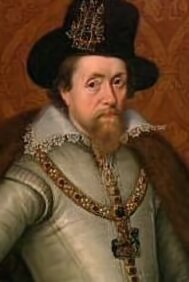
James contracted a marriage with the fourteen year old Anne of Denmark, the tall, fair haired daughter of Frederick II, in 1589, the marriage was carried out by proxy at Kronberg Castle in Oslo, Norway. Anne sailed for Scotland but was forced by storms to land on the coast of Norway. On hearing the crossing had been abandoned, James sailed from Leith with a large retinue to bring Anne to Scotland personally. The pair were formally married at the Bishop's Palace in Oslo on 23 November and, after stays at Elsinore and Copenhagen and a meeting with his new in-laws, James returned to Scotland with his bride on 1 May 1590. James was at first infatuated with Anne and in the early years of their marriage treated her with patience and affection. Anne of Denmark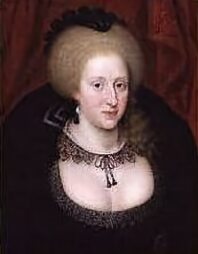 James's visit to Denmark, a country familiar with witch-hunts, may have inspired his interest in the study of witchcraft. Following his return to Scotland, he attended the North Berwick witch trials, the first major persecution of witches in Scotland under the Witchcraft Act of 1563. Several people were convicted of using witchcraft to send storms against James's ship. James was to become obsessed with the threat posed by witches and in 1597 wrote the Daemonologie, a tract that opposed the practice of witchcraft and which provided background material for Shakespeare's 'Macbeth.'
Despite his homosexual tendencies, James fathered several children with Anne, three of whom survived to adulthood. Henry Frederick, later Prince of Wales, was born in 1594, he was followed by a daughter, Elizabeth, later the Winter Queen of Bohemia in 1596, then Margaret in 1598, who died at fourteen months old. A second son, Charles, later Duke of York (and Charles I), was born at Dunfermline in 1600, Charles was at first a sickly child and it was not thought likely that he would survive. Then came Robert, born in 1601, Mary in 1605 and lastly Sophia in 1607, all of these last three children failed to survive to adulthood, Robert died at four months old, Mary at two years and Sophia at a day old. Mary and Sophia are buried at Westminster Abbey. The infant mortality rate was high in the seventeenth century, a fact of life that not even royalty could elude.
James I of England
From 1601, in the last years of Elizabeth I's life, English politicians, notably Elizabeth's chief minister Sir Robert Cecil, maintained a secret correspondence with James to prepare in advance for his smooth succession to the English throne. When Queen Elizabeth I died in 1603, James peacefully ascended the throne of England at the age of 37 by right of his descent from Margaret Tudor, the eldest daughter of King Henry VII. James left Edinburgh for London on 5th April and progressed slowly southwards. The English lords, his new subjects, entertained him with lavish hospitality along the route and James was amazed by the wealth of his new kingdom, announcing that he was 'swapping a stony couch for a deep feather bed'. He stayed at Cecil's house, Theobalds, in Hertfordshire, resulting in his arrival in London after Queen Elizabeth's funeral. The English people's first impressions of their new sovereign were not good. The new King's coarse and often vulgar sense of humour was not well received at the refined English court.
James later did his best to vindicate the memory of his mother and shortly after his accession to the English throne had her body removed from Peterborough to Westminster Abbey where he provided it with a magnificent white marble tomb. He defended her reputation, turned on his tutor Buchanan for his libels on his mother and termed her treacherous illegitimate half-brother, James, Earl of Moray, as that "bastard that who unnaturally rebelled and procured the ruin of his own sovereign and sister." However, James true feelings toward the mother he had never seen since babyhood remain an enigma.
religious policies seem to have evoked the opposition of both Catholics and Protestants alike. Two years after he ascended the throne the Gunpowder Plot was exposed. Guy Fawkes and several Catholic conspirators had planned to blow up the Protestant King and the Houses of Parliament, their plan very nearly reached fulfilment, Fawkes was arrested in a cellar under the Houses of Parliament in possession of touchpaper and matches and his horde of gunpowder uncovered. He was imprisoned and tortured in the Tower of London, many of the conspirators later suffered the horrific traitor's death of being hung, drawn and quartered.
Contemporary Description of James
'He was of middle stature, More corpulent through his clothes than in his body, yet fat enough, his clothes ever being large and easy, the doublets quilted for stiletto proof, his breeches in great pleats and full stuffed: He was naturally of a timorous disposition, which was the reason of his quilted doublets: His eyes large, ever rolling after any stranger came in his presence, insomuch, as many for shame have left the room, as being out of countenance: His beard very thin: his tongue too large for his mouth, and made him drink very uncomely, as if eating his drink, which came out of the cup of each side of his mouth. his skin was as soft as taffeta sarsnet, which felt so, because he never washed his hands, only rubbed his finger ends slightly with the wet end of a napkin. His legs very weak, having had (as was thought) some foul play in his youth, or rather before he was born, that he was not able to stand at seven years of age, this weakness made him ever leaning on other men's shoulders, his walk was ever circular, his fingers in that walk ever fiddling about his codpiece. He was very temperate in his exercises, and in his diet, and not intemperate in his drinking.'
He was very constant in all things (his favourites excepted) in which he loved change. He ever desired to prefer men in great places, that when he turned them out again, they should have no friend to bandy with them: and besides they were so hated by being raised from a mean estate, to over-top all men, that everyone held it a petty recreation to have them often turned out.' - Sir Anthony Weldon
ossessed of a high opinion of his own intelligence and a firm believer in the Divine Right of Kings, James' relationship with Parliament was inevitably fractious. Parliament objected to the manner in which he showered his successive favourites with money and titles. The King's reputation suffered further when his Protestant daughter Elizabeth and her husband Frederick of the Palatine were driven from Bavaria, and James failed to come to her aid.
Henry Frederick, Prince of Wales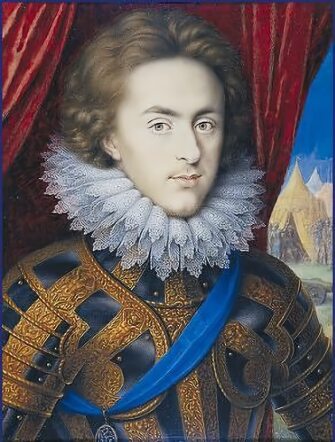
King James I, was the author of several books on varied subjects, the Divine Right of Kings being his favourite topic, but he also wrote about witchcraft, one of his pet subjects (widely believed in at the time) and a pamphlet on the perils of tobacco smoking.
Charles, Duke of York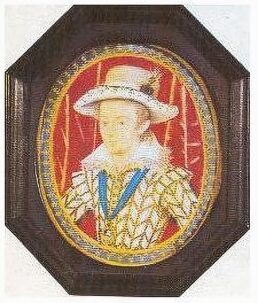
The Queen, Anne of Denmark, proved to be frivolous and frequently in debt. Largely neglected by her husband, she devoted herself to court entertainments and masques and loved expensive clothing. James' eldest son, the handsome and athletic Prince Henry was popular in England but unfortunately died before his father in 1612 at the age of eighteen. His younger brother Charles, Duke of York, became the new heir to the throne.
late 1617, Queen Anne was in failing health and began to suffer bouts of illness, James visited Anne only three times during her last illness, though her younger son Prince Charles often slept in the adjoining bedroom at Hampton Court Palace and was at her bedside during her last hours, when she had lost her sight. Queen Anne died aged 44 on 2 March 1619, of a dangerous form of dropsy. An inquest discovered Anne to be "much wasted within, especially her liver". James did not attend his wife's funeral, claiming illness, his symptoms, according to Sir Theodore de Mayerne, included "fainting, sighing, dread, incredible sadness..." Anne was buried in the south aisle of the Henry VII Chapel, Westminster Abbey, on 13 May 1619.
James' last favourite George Villiers, an effeminately beautiful young man whom he created Duke of Buckingham, was particularly unpopular. James left his son, Charles I, to reap the consequences of his disputes with the House of Commons and the growing ill-feeling between the monarch and Parliament. Despite his formidable learning, he was referred to as the "wisest fool in Christendom."
by nature, James prevented both England and Scotland from becoming involved in any European wars. He liked to be seen as the British Solomon. The great Henry IV of France once quipped that James saw himself as Solomon as he was indeed the "son of David" - a scathing reference to his mother's liaison with the Italian musician, David Rizzio.
The Death of James
In early 1625, James was plagued by severe attacks of arthritis, gout and fainting fits, and drifted into senility over the last year of his life. He died at Theobalds of a tertian ague, probably caused by kidney failure or a stroke, on 27th March 1625 at the age of fifty-nine. A theory has been put forward that James may have suffered from porphyria, a disease of which his descendant, George III, exhibited obvious symptoms. James' physician kept detailed notes on his royal patient, which describe his urine as being 'purple as Alicante wine' - a sure sign of porphyria.
's first Stuart King was buried at Westminster Abbey. In 1867 a search was made by Dean Stanley within the royal tombs for the final resting place of James I, which had gone unrecorded, he was found to share the tomb of the first Tudor King, Henry VII and his consort Elizabeth of York. James was succeeded on the thrones of England and Scotland by his second son, Charles I.
The Ancestry of James I and VI
James I & VIFather: Henry Stuart, Lord DarnleyPaternal Grandfather:Matthew Stewart, Earl of LennoxPaternal Great-grandfather: John Stewart, Earl of LennoxPaternal Great-grandmother:Anne StewartPaternal Grandmother:Lady Margaret DouglasPaternal Great-grandfather:Archibald Douglas, Earl of AngusPaternal Great-grandmother: Margaret TudorMother:Mary, Queen of ScotsMaternal Grandfather:James V, King of ScotsMaternal Great-grandfather: James IV, King of ScotsMaternal Great-grandmother: Margaret TudorMaternal Grandmother: Mary of GuiseMaternal Great-grandfather:Claude, Duke of GuiseMaternal Great-grandmother: Antoinette of Bourbon-VendômeThe family of James I and Anne of Denmark
Henry Frederick, Prince of Wales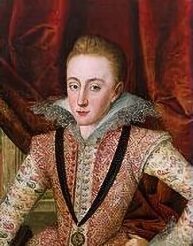
(1) Henry Frederick Stuart, Prince of Wales Died from typhoid fever at the age of 18 in 1612 Buried at Westminster Abbey.
(2) Elizabeth Stuart, Queen of Bohemia married Frederick V, Elector Palatine
(i) Henry Frederick, Prince of the Palatinate (1 January 1614 - 7 January 1629)
(ii) Charles I Louis, Elector Palatine (22 December 1617 - 28 August 1680)
(iii) Elisabeth of the Palatinate, Abbess of Herford (26 December 1618 - 11 February 1680)
(iv) Rupert of the Rhine, Duke of Bavaria, 1st Duke of Cumberland (1619 - 1682)
(v) Louise Hollandine of the Palatinate (18 April 1622 - 11 February 1709)
(vi) Prince Maurice of the Palatinate (17 December 1620 - September 1652)
(vii) Edward of Simmern, Count Palatine, 5 October 1625 - 10 March 1663
(vii) Henriette Marie, Princess Palatine (17 July 1626 - 18 September 1651
(viii) Sophia of Hanover 14 October 1630 - 8 June 1714 - from whom the
House of Hanover descend
(3) Margaret Stuart, Princess of Scotland (Margaret Stuart; 24 December 1598 - March 1600)
Margaret died at the age of 2 and was buried at Holyrood Abbey,
Charles, Duke of York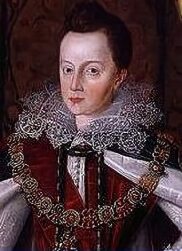
CHARLES I (19 November 1600 - 30 January 1649) married Henrietta Maria of France
(i) Charles James, Duke of Cornwall b. & d. 13 March, 1629.
(ii) CHARLES II 29 May, 1630- 6 February, 1685
(iii) Mary, Princess Royal 4 November, 1631-24 December, 1660
(iv) JAMES II & VII 14 October, 1633- 16 September, 1701
(v) Elizabeth 29 December, 1625-8 September, 1650
(vi) Anne 17 March, 1637 8 December, 1640
(vii) Catherine b. &d. 1639
(viii) Henry, Duke of Gloucester 8 July-1640-18 September, 1660
(ix) Henriette Anne 16 June,1644-30 June, 1670
(5) Robert Stuart, Duke of Kintyre (18 January 1602 - 27 May 1602)
Robert died at the age of 4 months and was buried at Dunfermline Palace, Fife, Scotland
(6) Mary Stuart of England, Scotland and Ireland (8 April 1605 - 16 September 1607)
Mary died of pneumonia at 17 months old and was buried at Westminster Abbey
(7) Sophia Stuart of England, Scotland and Ireland (22 June - 23 June 1606)
Sophia lived only a day and was buried at Westminster Abbey


