Mary, Queen of Scots
Mary Queen of Scots, after years spent incarcerated in English prisons, entered into secret correspondence with the Catholic Duke of Norfolk, the most powerful nobleman in England and Elizabeth's cousin on the Boleyn side. A plot was hatched where Mary was to marry Norfolk. Elizabeth, however, was informed. She confronted Norfolk, who denied all knowledge of the plot. The northern Earls rose but the revolt was easily put down.
Mary, Queen of Scots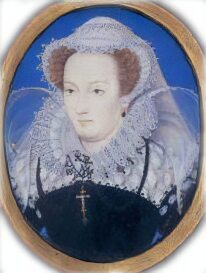
The Pope excommunicated the heretic Queen of England, thus compelling English Catholics to decide between their religion or their Queen. A second plot was formulated in 1571, known as the Ridolfi Plot, which again Norfolk was found to be involved in. Fortunately for the Queen, the plot was uncovered before it reached fruition. Norfolk was sent to the block, but the Queen, while thanking them for their loyalty, refused to countenance Parliament's request for the execution of the Queen of Scots.
Aware of the growing threat the arch Catholic Phillip of Spain posed to England, Elizabeth entered into marriage negotiations with the French in 1572, who were prepared to enter into an Anglo-French alliance to counter the balance of power in Europe, at the time stacked highly in Spain's favour.
The younger brother of Charles IX, Francis, Duke of Alencon, was offered as a candidate for Elizabeth's hand, negotiations were of course lengthy and stayed Phillip's hand. Elizabeth was over twenty years older than her prospective suitor, Alencon was short and pockmarked, she referred to him as her " Frog". The Queen was known to be dilatory, (especially with prospective suitors) and kept him in suspense until 1584 when she finally decided that she did not want to marry.
Elizabeth I, the Armada portrait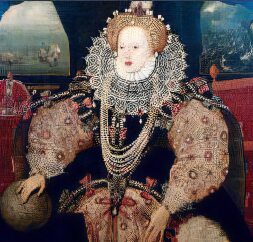
In the meantime, the Protestant Netherlands rose in revolt against Spanish rule. Elizabeth, recognising the opportunity to weaken Phillip and engage his attention elsewhere, supported the Dutch. Eventually, Spain put down the Dutch revolt, Leicester's expedition there after the assassination of the Dutch leader William the Silent ended in utter failure.
The captive Queen of Scots, having learned nothing from her previous disasters, was again involved in Catholic plots. Elizabeth's spymaster, Walsingham, was engaged in secretly monitoring the Scottish Queen's activities and correspondence.
When Mary involved herself in the Babington Plot in 1586 she sealed her fate. She was tried, condemned and the death sentence passed. Elizabeth could not bring herself to sign the Death Warrant, she agonised over it for months, being unable to make up her mind. On 1st February 1587, she, at last, brought herself to do so. It was, she said, a case of " strike or be stricken". Mary was beheaded at Fotheringay Castle in Northamptonshire, displaying immense courage and dignity at the last.
Mary was informed of her pending execution the night before it took place. She received the news calmly. At two in the morning, she wrote a letter to her brother-in-law, the King of France. Around 8 am on 8 February 1587, Mary Queen of Scots was led to the scaffold in the great hall of Fotheringhay Castle. An audible gasp was given out by the spectators as Mary removed her black dress to reveal a red petticoat, symbolising Catholic martyrdom. She kissed a crucifix and stated 'Even as Thy arms, O Jesus, were spread here upon the cross, so receive me into Thy arms of mercy and forgive me all my sins.' Mary knelt by the block and her eyes were covered by a cloth. She lay her head on the block, repeating in Latin 'In manus Tuas, Domine - 'Into thy hands, Lord'. Mary's head was removed with two blows of the executioner's axe. When he picked up her head to show the assembled crowd, Mary's wig came away in his hand revealing her grey hair was cut short. The Earl of Kent called out, 'Such end of all the Queen's and the Gospel's enemies.' Mary's small lapdog was found hiding under the dead queen's skirts, soaked in her blood.
Philip, provided with an excuse to attack the heretic Queen, launched the Spanish Armada in 1588. It was sighted off Cornwall on 19th July and warning beacons flared all along the south coast. The English naval forces were commanded by Drake, Hawkins, Frobisher and Howard of Effingham. Elizabeth went down to Tilbury, making her famous speech to the troops assembled there:-" I know I have the body of a weak and feeble woman, but I have the heart and stomach of a king and a King of England too." The country was ecstatic when news of the defeat of the Armada arrived and Elizabeth at the very peak of her fame.
Contemporary Descriptions of Elizabeth
There are various contemporary descriptions of Elizabeth in old age.
Paul Hentzen, tutor to a visiting nobleman, has left us an eye witness description of her:-
'Next came in the Queen in the sixty-fifth year of her age, as we were told, very majestic, her face oblong, fair, but wrinkled; her eyes small yet black and pleasant; her nose a little hooked; her lips narrow; and her teeth black ( a defect the English seem subject to from their too great use of sugar) she had in her ear two pearls, with very rich drops; she wore false hair and that red, her hands were small, her fingers long and her stature neither tall nor low; her air was stately; her manner of speaking mild and obliging.'
De Maisse, recorded in his journal after a meeting with the Queen:-
'She was strangely attired in a dress of silver cloth, white and crimson, or silver gauze as they call it. This dress had slashed sleeves lined with red taffeta, and was girt about with other little sleeves which hung down to the ground, which she was for ever twisting and untwisting. She kept the front of her dress open, and one could see the whole of her bosom, and passing low.'
He went onto add 'As for her face, it is and appears to be very aged. It is long and thin, and her teeth are very yellow and unequal, compared with what they were formerly, so they say, and on the left side less than on the right. Many of them are missing so that one cannot understand her easily when she speaks quickly. Her figure is fair and tall and graceful in whatever she does; so far as may be she keeps her dignity, yet humbly and graciously withal.'
The Later Years
Her later years saw Elizabeth I surviving her advisors, she kept Leicester's last letter for the rest of her life. Walsingham, Drake, Frobisher and finally Cecil, who had been her chief advisor from the beginning of her reign, died on 4 August 1598. Cecil was replaced by his son Robert Cecil.
Robert Devereux, Earl of Essex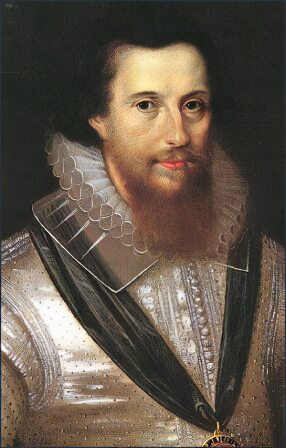 Most of Elizabeth's generation had passed away, the Queen adopted Leicester's step-son as her new favourite. Robert Devereux, Earl of Essex, was a handsome and high spirited if temperamental young man, he took liberties with the ageing queen but was forgiven. In April 1599 Elizabeth sent Essex to Ireland as Lieutenant and Governor-General, with an army of 17,000 men and explicit instructions to crush the Earl of Tyrone's rebellion and bring Ireland under control. Contrary to the Queen's orders, Essex had a secret meeting with Tyrone, made a truce in Elizabeth's name then abandoned his post to return to London and explain his decision to the Queen. The infuriated Elizabeth placed him under house arrest pending an inquiry. Although cleared of treason, Essex was found guilty of disobedience and dereliction of duty. He was consequently stripped of most of his positions and banished from court.
On his release in August 1600, Essex made failed attempts to regain his position as favourite and councillor, writing numerous pleading and outraged letters to the Queen. When Elizabeth refused to renew the lease and patent on his farm of wines in September 1600, the outraged Essex made plans to capture the Queen, rid the Council of his rival Robert Cecil and his supporters and proclaim James VI, the son of Mary, Queen of Scots, as her successor. Essex and his supporters commissioned a performance of Shakespeare's Richard II at the Globe Theatre on 7 February 1601, to be inspired by its famous deposition scene. Elizabeth, seeing through the plot remarked "I am Richard II, know ye not that?" The day after the play was performed Essex and his followers entered the City where they assumed they would be joined by the Londoners. However, the anticipated support did not materialize and the rebellion collapsed within the day. Essex was executed for treason on 15 February 1601. Elizabeth was both shocked and devastated by his betrayal.
Elizabeth addressed Parliament for the last time on 30 November 1601, in what is known as her Golden Speech, she told the assembled Houses of Parliament; " And though God has raised me high, this do I account the glory of my crown, that I have reigned with your loves." she finished 'For it is my desire to live nor reign no longer than my life and reign shall be for your good. And though you have had, and may have, many princes more mighty and wise sitting in this seat, yet you never had nor shall have, any that will be more careful and loving.'
The Queen, now sixty-nine, was in good health and spirits and her faculties remained sharp until the end. In the March of 1603, she began to feel unwell and retired to her favourite homes of Richmond Palace, close to the Thames. Melancholy engulfed her, causing insomnia, she knew she was going to die and refused food, nor would she go to bed but insisted on sitting on cushions on the floor, where she remained for four days, mostly without speaking. The Queen was eventually put to bed and dreamt she saw her "body thin and fearful dancing in the light of fire", perhaps she recalled her fears during the burnings of her sister Mary's reign. Archbishop Whitgift visited her and it is recorded that the Queen, though weak, squeezed his hand when he spoke of the rewards in Heaven that awaited her.
Tomb of Elizabeth I at Westminster Abbey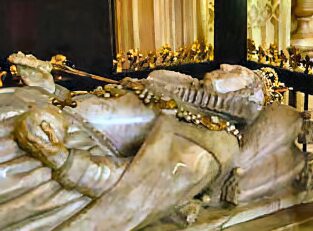
She was said to have indicated by a sign to Cecil that she accepted Mary, Queen of Scot's son, James VI, King of Scotland, as her successor, making a gesture with her hands, she drew a circle round her head to indicate a crown and confirm that this was her wish. Finally she lost the power of speech. The greatest of the Tudors fell into a deep sleep and died in the early hours of 24th March 1603, aged 69. It was the end of an era.
Since no post mortem took place the cause of Elizabeth's death remains unknown. She is generally believed to have died of blood poisoning, possibly caused by her white make-up, ceruse, a mixture of white lead and vinegar, the lead in the makeup being poisonous. It may have been a bronchial infection that turned into pneumonia, it is also possible that the great queen simply died of old age.
Elizabeth's body was carried from Richmond to Whitehall at night on a barge lit with torches, it then lay in state in a lead coffin at Whitehall, with a life-size effigy of the Queen, dressed in her royal robes, was placed on top of it to act as a symbol of the monarchy while there was no monarch in England. On the day of her funeral on 28 April, the coffin was taken to Westminster Abbey on a hearse drawn by four horses robed in black velvet. Elizabeth was then interred at Westminster Abbey in the vault of her grandfather, King Henry VII, until she was moved in 1606 to her present resting place, a tomb in the Henry VII Chapel at Westminster Abbey which she shares with her half-sister Mary I, at Westminster Abbey, deeply antagonistic to each other in life they were to lie together eternally in death. James I, later erected a fine effigy over Elizabeth's tomb, the Latin inscription at its base translates-
'Partners both in throne and grave, here rest we two sisters, Mary and Elizabeth, in the hope of one resurrection.'
Elizabeth I's Locket Ring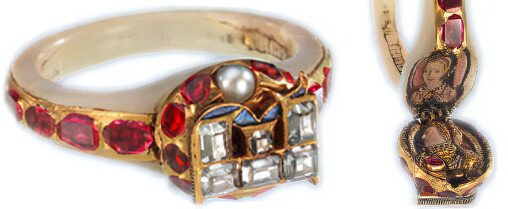
Though in her long reign Elizabeth hardly spoke about her mother Anne Boleyn, who had been disgraced and executed for adultery when she was but two years old, (Elizabeth is recorded as having only spoken of her mother twice in her entire lifetime), in about 1575 she commissioned a special piece of jewellery, in the form of a locket ring, which revealed how important Anne's memory was to her daughter.
The ring, which still exists today, consists of a ring of mother of pearl embossed small diamonds and rubies. The ring setting, or the front of the locket attachment, was set with six diamonds which formed the letter 'E' over a blue enamel 'R' stands for 'Regina'. The ring top also contains a pearl. It had a secret locket compartment which when opened reveals two miniature portraits side by side, one of is of Elizabeth and the other of her mother Anne Boleyn.
From 1575 until her death, Elizabeth never removed the ring from her finger; it only left her person after when it was taken to her successor, James VI of Scotland, as proof of her death, when its secret portraits were discovered. The ring now belongs to the Trustees of Chequers, the prime minister's country residence.
External LinksBess of Hardwick, the formidable Elizabethan Countess of Shrewsbury.
Mary Queen of Scots and Tutbury Castle- article on Tutbury Castle and the Scottish Queen's imprisonment there.


Elizabeth I Previous